
AURORA: Autonomous Updating of ROM and Controller via Recursive Adaptation
Overview
High-dimensional systems (like soft robots or thermal fluids) are notoriously difficult to control in real-time because their mathematical models are too heavy for fast computation. Engineers typically solve this by manually creating Reduced-Order Models (ROMs)—simplified approximations of the physics. However, these models are static; if the system changes (wear and tear, new environments), the controller fails.
We developed AURORA, a multi-agent LLM framework that automates the entire lifecycle of ROM-based control. It doesn’t just design the controller once; it acts as an autonomous engineer that continuously monitors performance. If the system drifts, AURORA detects the degradation, re-identifies the physics, updates the reduced-order model, and retunes the controller—all without human intervention.
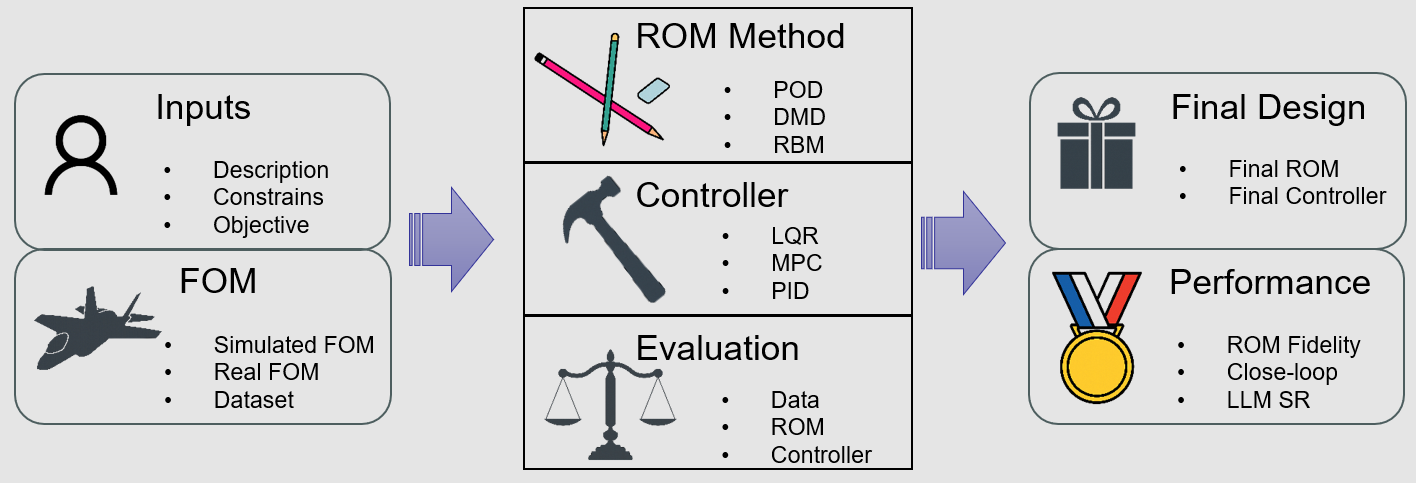 The closed-loop workflow where the Evaluation Agent triggers re-modeling cycles upon detecting performance degradation.
Motivation
Traditional ROM-based control faces fundamental limitations:
- Manual ROM construction requires expert knowledge and significant effort
- Static models degrade when system dynamics change over time
- No automatic mechanism to detect and correct model mismatch
- Controller failures require manual diagnosis and re-tuning
AURORA addresses these through autonomous, continuous adaptation.
The Recursive Adaptation Architecture
AURORA is not a single model but a team of five specialized AI agents orchestrated by a Manager:
| Agent | Role | Function |
|---|---|---|
| SysID Agent | Physics Discovery | Analyzes raw sensor data to identify governing equations |
| ROM Agent | Model Compression | Compresses high-dimensional dynamics using POD and related techniques |
| Control Agent | Controller Design | Designs optimal controllers (LQR/MPC) based on simplified ROM |
| CodeGen Agent | Implementation | Writes and verifies Python execution code |
| Evaluation Agent | The Watchdog | Monitors error metrics, diagnoses root causes, triggers update cycles |
The Evaluation Agent is the core of recursive adaptation—it continuously monitors performance and distinguishes between “Model Mismatch” vs. “Controller Aggression” to trigger targeted updates.
Quality Assurance: Judge-Correction Loop
A major risk with automated design is “silent failure”—code that runs but produces wrong physics. AURORA implements a rigorous QA protocol:
Validation Levels:
- Execution: Does it run without errors?
- Dimensions: Do matrices match expected shapes?
- Quality: Is the approximation error acceptably low?
- Physics: Is energy conserved? Are constraints satisfied?
If any check fails, the error log is fed back to the generating agent for self-correction. This loop reduced code generation errors to near zero in experiments.
Results
Validated on 8 diverse benchmarks ranging from simple systems (Building, n=48) to extreme complexity (Mobile Manipulator, n=156):
Overall LLM Performance
| LLM | Success Rate | Avg. Improvement | Full Auto | Avg. Iterations |
|---|---|---|---|---|
| GPT-5 | 7/8 | +8.9% | 5/8 | 7 |
| Qwen-2.5-72B | 6/8 | +7.1% | 4/8 | 7 |
| DeepSeek-V3 | 6/8 | +3.2% | 3/8 | 10 |
| GPT-5 mini | 5/8 | -7.2% | 2/8 | 13 |
| Llama-4 Maverick | 4/8 | -18.6% | 1/8 | 18 |
System Complexity Analysis
The framework scales across system complexity, with GPT-5 achieving success even on the most challenging Mobile Manipulator (n=156 states) where all other LLMs failed:
| Complexity | System | States | LLM Failures | Best LLM |
|---|---|---|---|---|
| Simple | Building | 48 | 0 | Qwen (+11.7%) |
| Simple | 7-DOF Manipulator | 42 | 0 | GPT-5 (+7.0%) |
| Moderate | ISS 1R | 270 | 2 | GPT-5 (+9.0%) |
| Moderate | Quadrotor | 288 | 2 | GPT-5 (+6.0%) |
| Complex | ISS 12A | 1412 | 3 | GPT-5 (+11.0%) |
| Extreme | Mobile Manipulator | 156 | 4 | GPT-5 (+12.0%) |
The framework demonstrated particular strength in high-dimensional systems where traditional ROM construction would require significant manual effort.
Technical Approach
AURORA’s recursive adaptation follows a principled workflow:
- Monitor: Evaluation Agent tracks control error metrics in real-time
- Diagnose: When error exceeds threshold, agent classifies root cause
- Update: Targeted re-identification of affected components (ROM or controller)
- Validate: QA loop ensures updated model passes all verification checks
- Deploy: New controller seamlessly replaces old one
This enables self-healing control that maintains performance despite system drift.
Tools & Implementation
- ROM Techniques: Proper Orthogonal Decomposition (POD), Dynamic Mode Decomposition
- Control Methods: LQR, MPC designed on reduced-order models
- LLM Backend: Compatible with GPT-4, Claude-3, and other frontier models
- Validation: Multi-level QA with physics-based consistency checks
Publication
Li, J., Li, S., & Chen, D. (2025). AURORA: Autonomous Updating of ROM and Controller via Recursive Adaptation. In Preparation.
@article{li2025aurora,
  title={AURORA: Autonomous Updating of ROM and Controller via Recursive Adaptation},
  author={Li, Jiachen and Li, Shihao and Chen, Dongmei},
  journal={In Preparation},
  year={2025}
}
Related Projects
- S2C: LLM Multi-Agent Control Synthesis — Certified H∞ controller synthesis with LLMs
- LLM-Assisted Control for R2R — Multi-agent framework for manufacturing systems