
Physics-Based Modeling of Adhesion Dynamics in R2R Lamination
Overview
In flexible electronics and solar cell manufacturing, lamination is the critical step where multi-layered materials are bonded under heat and pressure. Adhesion force is the metric of success, but it is notoriously difficult to predict because it depends on a complex interplay of viscoelasticity, thermodynamics, and contact mechanics.
We developed a Physics-Based Process Model that explicitly integrates Hertzian Contact Theory with transient heat transfer equations. Unlike black-box empirical models, this framework predicts exactly how machine parameters (roller speed, temperature, compression force) translate into bonding strength.
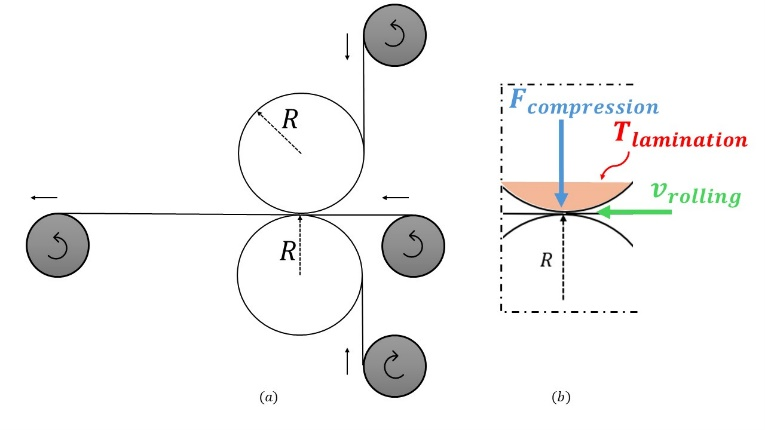 Schematic of the R2R lamination process showing key inputs: compression force (F), temperature (T), and web velocity (v).
Motivation
Traditional approaches to lamination process optimization rely on:
- Expensive trial-and-error experimentation
- Empirical models that don’t generalize across materials
- Conservative operating parameters that limit throughput
A physics-based model enables:
- Predictive process design before physical trials
- Understanding of parameter interactions
- Identification of optimal operating strategies
The Physics Engine
The model couples two physical domains:
Mechanical Domain: Hertzian Contact
We model the nip (contact zone) between rollers as a cylindrical Hertzian contact, calculating exact effective contact pressure and width rather than assuming flat interaction:
- Contact width depends on total force, effective radius, and material properties
- Maximum pressure distribution follows Hertzian profile
- Contact time determined by web velocity and contact width
Thermal Domain: Transient Heat Transfer
Adhesion is treated as a thermally activated process following an Arrhenius-type law. The model tracks temperature evolution through the multi-layer stack (PET-EVA-PET) as it moves through the heated zone:
- Conduction through substrate layers
- Interface temperature at bonding surface
- Melt transition of adhesive layer (EVA)
Results: The Adhesion Surface
The model generates a 3D “Adhesion Surface” that serves as a manufacturing process map, visualizing the safe operating zone where temperature and pressure ensure adequate bonding.
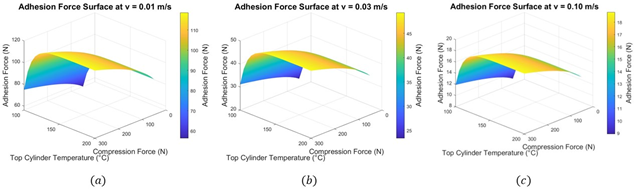 3D surface plots predicting adhesion force as a function of temperature and pressure across different speeds. Note how the “safe zone” shrinks at higher speeds.
Key observations:
- Low Speed (0.01 m/s): High adhesion achievable across wide range of pressures
- High Speed (0.10 m/s): Safe zone shrinks drastically—only maximal temperatures (200°C+) and high compression maintain bond integrity
Model Validation
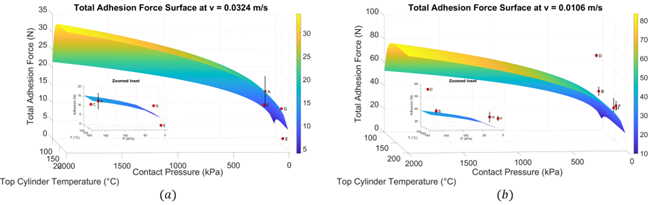 2D contour plots with experimental data points overlay, demonstrating model accuracy across operating conditions.
Optimization: Dual-Heating Strategy
A key insight from thermal analysis was the bottleneck in heat transfer through substrate layers. We simulated a Dual-Roller Heating strategy (heating both top and bottom rollers):
| Configuration | Time to Target (87°C) | Improvement |
|---|---|---|
| Single Roller | 0.337 s | Baseline |
| Dual Roller | 0.126 s | 62.6% faster |
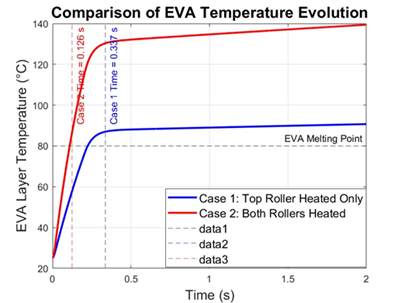 Comparison of EVA layer temperature rise: dual-heated configuration (red) shows significantly steeper slope, reaching target temperature 62.6% faster.
This reduction in heating time means production line speed can be more than doubled while maintaining the same adhesion quality.
Impact
The physics-based model enables:
- Process optimization without extensive physical trials
- Material selection guidance based on thermal properties
- Equipment design insights for dual-heating configurations
- Quality prediction across operating conditions
Tools & Implementation
- Contact Mechanics: Hertzian theory for cylinder-on-cylinder contact
- Heat Transfer: Transient conduction through multi-layer stack
- Validation: Custom R2R lamination testbed + Instron peel testing
- Application: Flexible electronics, solar cell manufacturing
Publication
Li, S., Martin, C., Morquecho, E.V., Chen, Z., Chen, D., & Li, W. (2025). Modeling of Adhesion Dynamics in Roll-to-Roll Lamination Processes. Manufacturing Letters, 44, pp.552-558. [Published]

@article{li2025adhesion,
  title={Modeling of Adhesion Dynamics in Roll-to-Roll Lamination Processes},
  author={Li, Shihao and Martin, Christopher and Velasquez Morquecho, Enrique and Chen, Zijun and Chen, Dongmei and Li, Wei},
  journal={Manufacturing Letters},
  volume={44},
  pages={552--558},
  year={2025}
}
Related Projects
- RLMPC: Repetitive Learning Control — Real-time learning control for R2R manufacturing
- LLM-Assisted Control for R2R — Multi-agent framework for R2R systems
- Curriculum-Based SAC for R2R — Deep reinforcement learning for tension control